• 1
  • 2
  • 3
  • 4
  • 5
  • 6
  • 7
  • 8
  • 9

The HIV Funding Request

All funding requests submitted to the Global Fund on the 23rd May 2017 are tailored applications, which means that they primarily describe those interventions that are subject to change while maintaining a large number of existing interventions. Because of the high HIV and TB co-infection rate, Ghana was required to submit a joint HIV/TB funding request.

The HIV funding request is based on the finding that there are high HIV prevalence areas in all regions and proposes therefore to focus on high prevalence districts instead of the current high prevalence regions in order to achieve the overarching goal of eliminating Mother-To-Child Transmission (MTCT) of HIV. 

This funding request aims to increase:

  1. PMTCT - ART coverage from 36% in 2016 to 82% in 2020 through adoption of task shifting and expansion of ART services at ANC level and associated OPD of 400 healthcare facilities, thereby also improving coverage of early infant diagnosis of children born to HIV+ mothers; The 400 health facilities targeted are located in 163 districts across all ten regions.
  2. The percentage of HIV-positive TB patients on ART from 43% in 2016 to 82% in 2020; and
  3. Quality of HIV care and treatment adherence rates through expansion of the ART clinic network and associated reduction of work load in all existing ART clinics.
  4. ART initiation among HIV-positive key populations from 29% among MSM and 35% among FSW in 2016 to 82% in both groups in eight selected districts by 2020.  

 The above objectives shall be achieved through:

  1. Training of midwives/nurses and medical assistants to initiate ART, provide ART care, collect EID samples and screen for TB at 400 health facilities that have 83% of HIV+ pregnant women (2016)
  2. Integrate HIV services in ANC and OPD to reduce travel cost and the risk of stigma.
  3. Capture PLHIV data in the eTracker component of DHIMS 2 for an improved follow up of individual patients for continuum of care, adherence and retention.
  4. Sensitize health facility workers on appropriate attitudes towards patients irrespective of their sexual orientation, gender, legal status, HIV status and medical condition.

An amount of US$63,214,477 is requested for the HIV component, of which almost 45m US$ will be required for ART care (ART and laboratory tests) for 104,000 existing PLHIV in this three year period 2018-2020.

The RSSH Funding Request

While all funding requests submitted to the Global Fund on the 23rd May 2017 are tailored applications, it is the first time that the Ghana CCM submits a request for a separate RSSH component. The RSSH funding request is integrated in the Malaria / RSSH funding request. It shall address systemic risks and weaknesses that impede the effective implementation of the malaria, HIV and TB grants.

The Health Systems Strengthening part aims at:

  1. Improving the Procurement and Supply Chain Management Systems through a fully functional Logistics Management and Information System, greater geographical coverage of Last Mile Distribution, and optimization of warehousing processes (5.5m USD)
  2. Enhancing Financial Management Systems at all levels (2.4m USD)
  3. Improving Health Management Information Systems and M&E, e.g. through scale up of the e-tracker to cover 40% of the facilities, implementation of a Human Resource Information System, and support of the implementation of task sharing of HIV, TB, malaria services (1.2m USD)

The Community Systems Strengthening module seeks to support community-led social accountability and advocacy efforts to complement Government’s efforts to improve access to and quality of services in healthcare facilities (2.5m USD).

The TB Funding Request

All funding requests submitted to the Global Fund on the 23rd May 2017 are tailored applications, which means that they primarily describe those interventions that are subject to change while maintaining a large number of existing interventions. Because of the high HIV and TB co-infection rate, Ghana was required to submit a joint HIV/TB funding request.

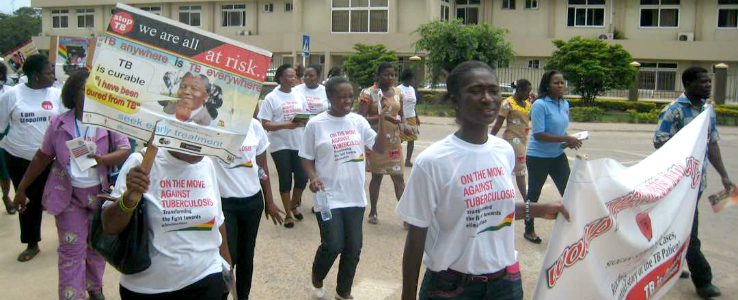
Case finding is considered as the biggest challenge. The funding request aims at increasing case detection from current levels of 55 cases per 100,000 population to 62 cases per 100,000 in 2020 with the option to achieve 90 per 100,000 once funds become available to over all 216 districts. The following interventions are proposed:

  1. Targeted supervision at healthcare facilities with Intensified Case Finding in 113 prioritized districts to ensure that at least 80% of presumed TB cases are tested and 100% of confirmed TB cases are initiated on treatment.
  2. In the 113 prioritized districts, TB diagnosis will be based on GeneXpert and Digital X-ray to double case detection as the current smear microscopy identifies only about one third of the cases.
  3. Countrywide DR-TB and HIV/TB screening, diagnosis and treatment using the new shorter MDR-TB regimen.
  4. Targeted childhood TB-screening for children under five years integrated into Seasonal Malaria Chemoprevention (SMC) in Upper East and Upper West Regions as well as MNCH services.
  5. Screening in high-risk populations (mining areas, urban slums and prisons) using mobile outreach.
  6. Household contacts investigation of at least 50% of all bacteriologically confirmed new TB cases.
  7. Partnering private sector to increase TB case detection and
  8. TB stigma reduction activities led by a National TB ambassador.

An amount of US$14,891,925 is requested for the TB component, of which 8.4m US$ will be required for TB care and prevention and further 4.8m USD for MDR-TB. 

Global Fund News

Feed not found.